
MCAS vs. Histamine Intolerance vs. Food Allergy
MCAS vs. Histamine Intolerance vs. Food Allergy: How to Tell the Difference
The short version
- Food allergy is an IgE-mediated immune reaction to a specific protein. It is reproducible, testable, and can be life-threatening.
- Histamine intolerance is a clearance problem. The body cannot break histamine down fast enough, so it accumulates from food. It is dose-dependent.
- MCAS is a release problem. Mast cells throughout the body over-activate and release histamine plus dozens of other mediators, usually affecting two or more organ systems at once.
- They can occur together, and MCAS can look like histamine intolerance — which is why the order in which you treat them matters.
Mitchell Medical Group · Medically reviewed by Dr. Dean Mitchell, MD · Last reviewed August 1, 2026
If you react to foods, your allergy testing came back negative, and you have been told your symptoms are stress or IBS, you are almost certainly weighing three explanations against each other: mast cell activation syndrome, histamine intolerance, or a food allergy nobody has found yet.
They are not the same condition, they are not diagnosed the same way, and — the part that matters most — they are not treated the same way. Dr. Dean Mitchell, a board-certified allergist and immunologist practicing in Manhattan and Rockville Centre, Long Island, and by telehealth nationwide, sees patients with mast cell activation syndrome every week, and this is one of the most common untangling jobs that walks through his door.
Here is how the three differ.
What is the difference between MCAS, histamine intolerance, and food allergy?
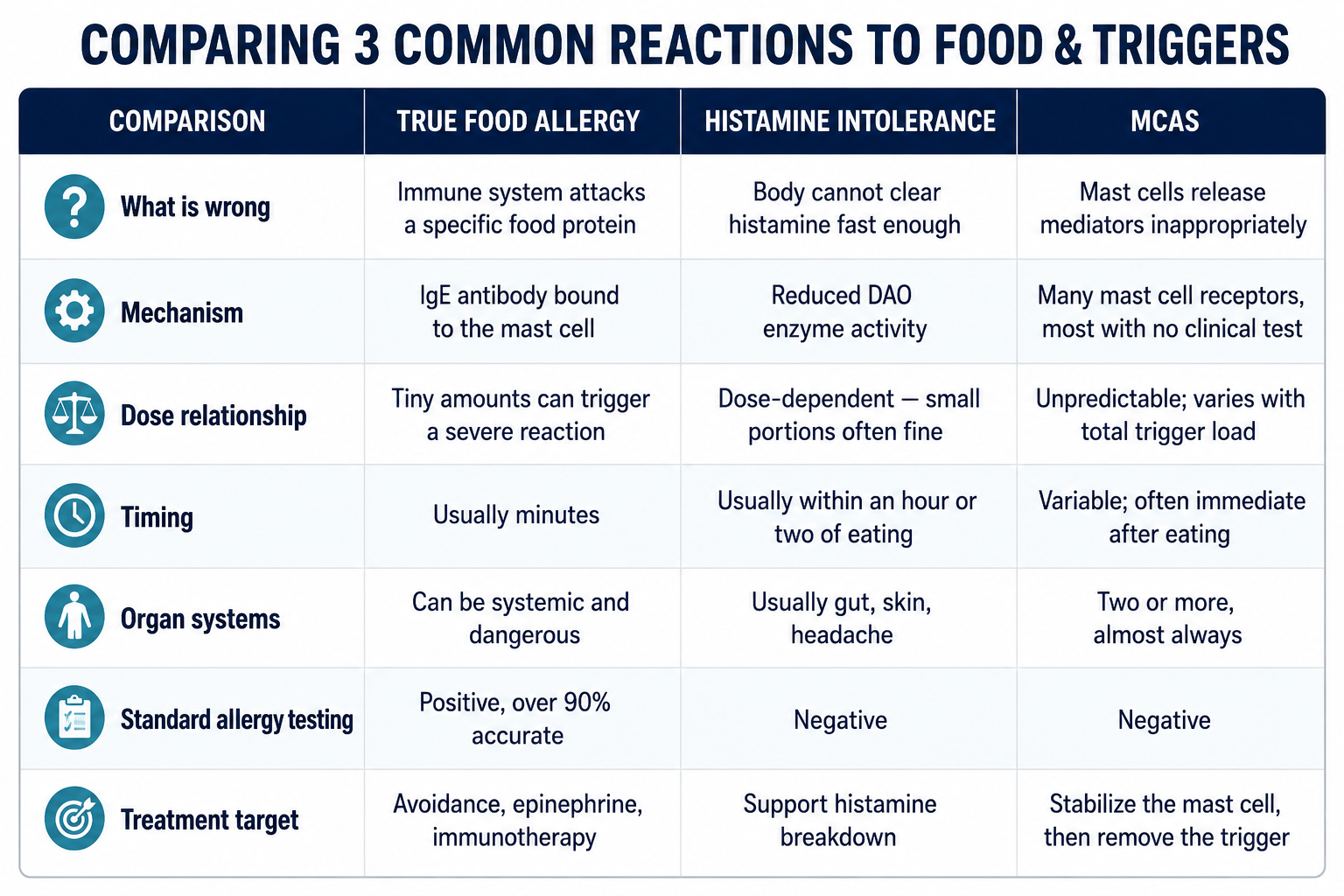
The difference is mechanism. A food allergy is an IgE-mediated immune reaction to a specific food protein – peanut, tree nut, shellfish – that is reproducible and shows up on testing. Histamine intolerance is a clearance problem: the body cannot break histamine down fast enough, so histamine from food builds up. MCAS is a release problem: mast cells throughout the body are inappropriately activated and release histamine along with dozens of other chemical mediators, whether or not food is involved.
That distinction drives everything downstream — what testing is worth ordering, what a reaction looks like, and what treatment actually works.
What is a true food allergy, and how is it different?
A true food allergy is an IgE-mediated reaction. Your immune system has made a specific antibody to a specific food protein, that antibody sits on the surface of your mast cells, and when you eat that food the antibody binds it and the mast cell releases its contents immediately. It is reproducible, it is testable, and it can be dangerous.
Dr. Mitchell describes the mechanism directly:
“The mast cell has a lot of different receptors. One of those receptors looks like a little Y when you look at a picture of it. That’s the IgE receptor, and that receptor on the mast cells is the type that binds to allergens… The skin and blood testing for this kind of test is quite good. It’s over 90 percent accurate.” — Dr. Dean Mitchell, MD
The dose relationship is what separates it from the other two. In his words, “a small fraction of a peanut could set off a mast cell in a dangerous anaphylactic reaction.” There is no safe portion size.
So the fork is clean. If your allergy testing is positive and your reactions are reproducible, this is a food allergy, and the question becomes treatment rather than diagnosis — that conversation lives here: food allergy treatment options.
If your testing came back negative and you are still reacting, keep reading. That is the situation the rest of this page is about, and it is the single most common reason patients end up in Dr. Mitchell’s office still without an answer.
What is histamine intolerance?
Histamine intolerance means your body cannot degrade histamine efficiently enough to keep up with what you take in. It is not an allergy and it is not an immune reaction — it is an enzyme shortfall.
“Histamine intolerance tends to really indicate that a person, a lot of times genetically, doesn’t have the enzymes to degrade histamine enough. And there are certain genes, like one of them is called the DAO gene, that if somebody has a mutation in that, they can be missing some of the enzymes that are needed to degrade histamine. So if they eat certain foods with high histamine content, they can react.” — Dr. Dean Mitchell, MD
The signature feature is that it is dose-dependent. Dr. Mitchell’s illustration: a small piece of avocado is usually fine; half an avocado or a whole one may overload the system. That gradation is diagnostically useful, because a true peanut allergy does not behave that way.
The classic high-histamine foods he names are avocado, spinach, eggplant, and aged cheeses, with tomatoes carrying a lesser load. Fermented foods — sauerkraut, kimchi, kombucha — are also high, which catches patients off guard because those foods are widely marketed as universally healthy.
He also flags that the load is cumulative, and he has seen it play out: one patient became quite ill from a daily smoothie combining several high-histamine ingredients that would each have been tolerable alone.
What is MCAS?
Mast cell activation syndrome is a release problem rather than a clearance problem. Mast cells sit in nearly every tissue in the body, and in MCAS they activate inappropriately and release histamine along with tryptase, prostaglandins, leukotrienes, and dozens of other mediators.
Two features distinguish it. First, it is multi-system — Dr. Mitchell looks for symptoms crossing two or more organ systems, which is why these patients accumulate a dermatologist, a gastroenterologist, a neurologist, and a rheumatologist without any of them finding the thread. Second, the trigger is usually not food at all.
“For the most part, most of the patients with mast cell activation that I see don’t have essentially histamine intolerance. Their mast cells are overactivated from either environmental exposures like mold, allergens, or any kind of various toxin or infection.” — Dr. Dean Mitchell, MD
That is the reframe most patients arrive without. If the mast cells are being driven by mold exposure or a lingering infection, no amount of dietary histamine restriction resolves it — which is exactly the pattern that lands people in his office after a year of increasingly restrictive eating with no improvement.
How MCAS, Candida, and mold illness interact when all three are active is its own subject.
Can you have MCAS and histamine intolerance at the same time?
Yes — and this overlap is the single most common reason patients get stuck.
“If you have mast cell activation syndrome and you’re releasing all of those chemicals in the mast cells — tryptase, histamine, prostaglandins — the histamines could potentially overload the person’s system. So that would cause what appears to be like a histamine intolerance.” — Dr. Dean Mitchell, MD
Read that carefully, because it is the clinical crux of this entire post: MCAS can manufacture the appearance of histamine intolerance. A patient whose mast cells are dumping histamine all day will fail every high-histamine food they eat and will reasonably conclude they have histamine intolerance. They will restrict their diet. They will not get better, because the histamine driving their symptoms is not coming from their food.
In that patient, the histamine problem is a downstream effect. Treating it as the root cause is how people spend two years on an elimination diet that was never going to work.
Why is my allergy testing negative if I react to everything I eat?
Because standard allergy testing measures one receptor, and the mast cell has many.
Allergy skin and blood testing look for IgE antibodies bound to the IgE receptor. That test is excellent — over 90 percent accurate — at what it measures. But the mast cell carries a large number of other surface receptors that can also trigger release, and for most of them there is no routine clinical blood test. Dr. Mitchell gives a clinical example: patients reporting allergies to five different antibiotics were dismissed for years, until a specific mast cell receptor was identified that made them drug-reactive. That finding remains research-grade — there is still no test for it in clinical practice.
His practical conclusion: negative testing rules out IgE allergy. It does not rule out MCAS. In fact, an immediate reaction after eating in a patient whose allergy panel is clean is, in his words, “the harbinger of mast cell activation.”
How does Dr. Mitchell actually tell them apart?
By history – not by lab panel. This is the part that differs most sharply from how these patients are usually worked up.
“It’s really very difficult for the histamine intolerance, because histamine in the blood is very transient. A lot of times it’s not elevated… And mast cell activation, that’s also tricky, because lab findings in most cases are normal.” — Dr. Dean Mitchell, MD
There is no single blood test that resolves the question. A tryptase level or a urinary prostaglandin D2 can support an MCAS diagnosis when elevated, but they are frequently normal in patients who genuinely have it — and normal results are routinely used to tell patients nothing is wrong.
So the differentiation is clinical, and it comes out of a genuinely detailed history: what the reaction looks like, how quickly it comes on, whether portion size changes the outcome, how many organ systems are involved, what else was happening in the patient’s life and environment when the symptoms began.
This is where Mitchell Medical Group works differently from most specialist practices. Dr. Mitchell takes every patient’s full medical history himself, in every consultation. There is no medical assistant, nurse, or physician in training who collects your history and relays it to him. Given that the diagnosis here is made almost entirely from the history, that is not a service detail — it is the diagnostic method. In his own framing, the history does roughly ninety percent of the work.
Why the treatment is different – and why the distinction is worth getting right?
Each of the three mechanisms points to a different intervention, and matching them is the whole point of the exercise.
For MCAS, the goal is to stop the release. Dr. Mitchell’s objection to leading with antihistamines alone is that they act after the fact:
“With mast cell activation, one of the unique things I try to do is stabilize the mast cells so they don’t release histamine. And there are certain compounded medications like ketotifen, which I’ll have made up and prescribed. With histamine intolerance, the histamine is out there already — and so the patient needs to be taking the enzymes that are necessary to degrade the histamine.” — Dr. Dean Mitchell, MD
For histamine intolerance, the histamine is already circulating, so the approach is enzyme support plus reasonable attention to dietary load. He does recommend DAO supplementation where appropriate, but as a complement rather than a substitute — it does not license eating whatever you want.
For true food allergy, avoidance and emergency preparedness are the baseline, and immunotherapy is the treatment conversation.
He is also direct about over-correction. On strict low-histamine diets: “when I do have people come in and go, I’m on a histamine-free diet, that includes almost all kinds of foods. And you can really limit your diet way too much when it’s not necessary.” These patients are usually restricting heavily already. Adding restriction without a diagnosis is not a neutral act.
What about delayed reactions to red meat?
There is a fourth pattern worth naming, because it fits none of the three above and is frequently missed. Patients who develop hives, vomiting, or a serious drop in blood pressure roughly three hours after eating red meat may have alpha-gal syndrome — a sensitivity triggered by a tick bite that produces antibodies to a sugar molecule found in mammalian meat.
The delay is what disguises it. By the time symptoms begin, dinner is hours behind them, and standard allergy testing at the time did not look for it. Dr. Mitchell has seen this pattern concentrated in parts of New York, including Long Island and the Hamptons, and the reactions can be severe. It requires a specific test, and it is a separate diagnosis from both MCAS and histamine intolerance — though the mast cell is the cell doing the damage in all of them.
Frequently Asked Questions
What is the difference between MCAS and histamine intolerance?
Histamine intolerance is a problem of clearance: the body cannot break histamine down fast enough, often because of reduced DAO enzyme activity, so histamine from food accumulates. MCAS is a problem of release: mast cells throughout the body are over-activated and dump histamine plus dozens of other mediators, whether or not food is involved. Dr. Mitchell describes histamine intolerance as dose-dependent, where a small portion of a high-histamine food is tolerated and a large portion is not. MCAS reactions are far less predictable and usually involve two or more organ systems at once.
Can you have MCAS and histamine intolerance at the same time?
Yes, and the overlap is common enough that it confuses the diagnosis. When mast cells are chronically activated they release large amounts of histamine along with tryptase and prostaglandins. That histamine load can overwhelm the enzymes that normally clear it, so a patient with MCAS can look exactly like a patient with histamine intolerance. In that situation the histamine problem is a downstream effect, not the root cause, which is why stabilizing the mast cells is the priority.
Is MCAS a food allergy?
No. A true food allergy is an IgE-mediated immune reaction to a specific protein, such as peanut, tree nut, or shellfish, and it is reproducible and testable. MCAS food reactions are usually not IgE-mediated, which is why standard allergy testing comes back negative in these patients. Dr. Mitchell notes that an immediate reaction after eating, in a patient whose allergy testing is negative, can be one of the earliest signals of mast cell activation rather than allergy.
Why is my allergy testing negative if I react to so many foods?
Standard skin and blood allergy testing measures IgE antibodies bound to one specific receptor on the mast cell. That testing is highly accurate for true IgE food allergy. But mast cells carry many other receptors that can trigger release, and there are no routine clinical blood tests for most of them. So a patient can be reacting through a genuine mast cell mechanism and still test negative on a full allergy panel. Negative testing rules out IgE allergy. It does not rule out MCAS.
What is the DAO enzyme and how does it relate to histamine intolerance?
DAO, or diamine oxidase, is the enzyme that breaks down histamine taken in from food. Some people carry a genetic variation that leaves them with reduced DAO activity, so histamine from foods accumulates instead of clearing. Dr. Mitchell notes that true DAO-related histamine intolerance is considerably less common than patients assume, and considerably less common than MCAS in the patients he sees. He does recommend DAO supplementation in appropriate cases, but as a complement to sensible eating rather than a license to eat anything.
Which foods are highest in histamine?
Dr. Mitchell consistently names the same short list as the classic high-histamine foods: avocado, spinach, eggplant, and aged cheeses. Fermented foods such as sauerkraut, kimchi, and kombucha also carry a high histamine load, which surprises patients who have been told those foods are universally healthy. Alcohol, particularly red wine and beer, can release histamine as well. The load also accumulates, so a smoothie combining several high-histamine ingredients can cause a reaction that any single ingredient would not.
Does a blood test show whether I have MCAS or histamine intolerance?
Usually not on its own. Blood histamine is highly transient and is often normal even in a patient who reacts. In MCAS, laboratory findings are normal in most cases as well, although an elevated tryptase or urinary prostaglandin D2 can support the diagnosis when present. Dr. Mitchell orders a tryptase level primarily to rule out other mast cell disorders. The clinical history, not the lab panel, does most of the diagnostic work.
Are the treatments for MCAS and histamine intolerance different?
Yes, and the difference follows directly from the mechanism. For MCAS, the goal is to stop the release, which Dr. Mitchell approaches with a compounded mast cell stabilizer alongside H1 and H2 blockers, then identifies and removes the underlying trigger. For histamine intolerance, the histamine is already present, so the approach is enzyme support and attention to the histamine load in the diet. Treating one as if it were the other is a common reason patients stay stuck.
Should I be on a strict low-histamine diet?
The clinical position Dr. Mitchell takes is that strict low-histamine diets are frequently overdone. Most published low-histamine food lists exclude nearly everything, and patients with complex immune conditions are often restricting their diets heavily already. His guidance is to remove the highest-histamine foods for a defined trial period, assess honestly whether symptoms improved, and reintroduce carefully rather than restricting indefinitely. Undue restriction carries its own nutritional and psychological cost.
What about delayed reactions to red meat?
Delayed reactions occurring roughly three hours after eating red meat point toward alpha-gal syndrome, a tick-transmitted sensitivity that produces antibodies to a sugar molecule found in mammalian meat. It is a distinct diagnosis from both MCAS and histamine intolerance, it is common in parts of New York including Long Island and the Hamptons, and it is frequently missed because the delay makes the food connection non-obvious. It requires specific testing, and reactions can be severe.
Where to start if you do not know which one you have
Start with the history — yours. Before an appointment, write down what you react to, how quickly, whether the amount changes the outcome, and which body systems are involved. That record is worth more than another round of testing.
Dr. Mitchell sees patients at Mitchell Medical Group’s Manhattan and Rockville Centre offices, and by telehealth nationwide for patients outside New York. He conducts every consultation and takes every history personally.
Request a meeting with Dr. Mitchell.
CONNECT WITH US:
About Dr. Dean Mitchell, MD — Board-Certified Allergist & Immunologist
 Manhattan & Rockville Centre, Long Island · Telehealth nationwide · 30+ years in practice · Sackler School of Medicine · Robert Cooke Allergy Institute · Adjunct Clinical Professor, Touro College of Osteopathic Medicine · Fellow, AAAAI
He has spent years diagnosing and treating Mast Cell Activation Syndrome (MCAS) — including patients who went undiagnosed for years because MCAS overlaps with so many other conditions — and sees new MCAS cases in his practice every week.
You work directly with Dr. Mitchell. He takes every patient’s full medical history himself, in every consultation — there is no medical assistant or trainee taking your history and relaying it back, and no patient care team in between.
Specialties: Candida & microbiome · MCAS · Toxic mold illness / CIRS · Food allergies · Allergy drops (SLIT)
Featured in: New York Times · Daily Mail · SELF · Martha Stewart · HuffPost · Fox News · ABC · Intelligent Medicine Podcast · Natural Awakenings
Podcast: Host — The Smartest Doctor in the Room · 230+ episodes featuring Harvard, Stanford & NIH researchers · Spotify & Apple Podcasts
Books: Conquering Candida: The New 30-Day Protocol (2025) · The Allergy and Asthma Solution (2006)
CONNECT WITH US:
*This post contains affiliate links.
From stress overload to chronic inflammation, vagus nerve stimulation (VNS)…

CONNECT WITH US:
Ozempic, Mounjaro, and the Truth About Weight Loss
Fasting vs Weight Loss Medications – Which Works Best
You’ve…